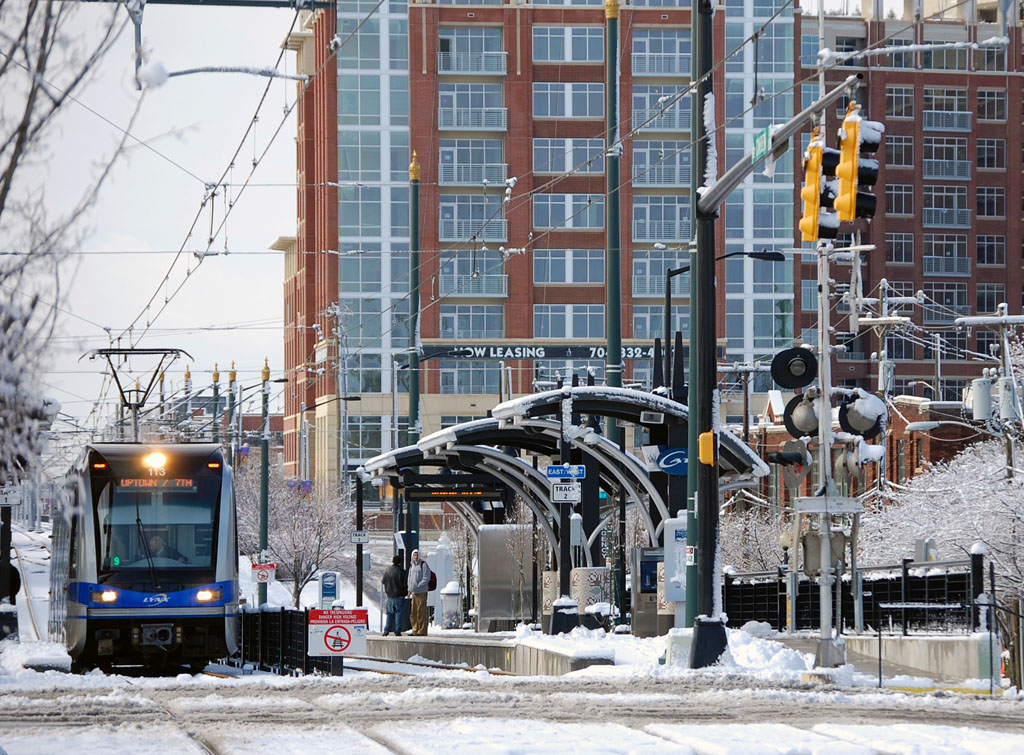
Ballantyne's long-awaited Blue Line extension is among the transit projects at risk as Charlotte's new transportation sales tax faces revenue growth well below projections.
The one-cent tax that Mecklenburg County voters approved in November 2025 is projected to generate about $19.4 billion over 30 years, assuming 4% average annual growth. Recent collections on the existing half-cent transit tax tell a different story. Revenue grew less than 1% from 2023 to 2024, rebounded to 4% from 2024 to 2025, and is expected to be flat or decline for the fiscal year ending June 2026, WFAE reporter Steve Harrison reported Wednesday, Aug. 26.
The stakes are steep. If the new tax averages 3% annual growth instead of 4%, the Charlotte Area Transit System (CATS) financial model shows it would generate $3 billion less over three decades. At 2.5% growth, the shortfall balloons to nearly $4.5 billion.
That math hits the proposed Silver Line light rail hardest. The line from Charlotte Douglas International Airport to Bojangles Coliseum carries a $3.3 billion price tag, and its main segment cannot be broken into smaller pieces because it would be unlikely to qualify for federal funding. If there is not enough money to build it in the next decade, rising construction costs could push the project further out of reach, according to the WFAE/Charlotte Ledger report.
For Ballantyne, the picture is no brighter. CATS said in an October 2025 WFAE report that the full Blue Line extension to Ballantyne would cost $1.8 billion and that it does not have enough money for that route. The funded segment ends at Carolina Place Mall in Pineville.
The new one-cent tax took effect July 1 and is projected to generate between $328 million and $335 million in the current fiscal year ending June 2027. Forty percent goes to roads; the rest funds transit.
CATS said in a statement that its 30-year plan relies on long-term average growth rates designed to avoid over- or underestimating future conditions. The agency added that it does not see indications requiring major changes to the plan's direction.
Peter Rogoff, former head of the Federal Transit Administration (FTA) and the Seattle transit system, offered a less reassuring view. "I have heard some grumbles of sales taxes underperforming projections in certain jurisdictions," Rogoff told Harrison.
A Charlotte Ledger analysis of N.C. Department of Revenue data found that taxable sales in Mecklenburg County totaled $37.13 billion in the year ending June 2026, up 3.1%. That trailed the statewide average of 4.7% and was slower than every surrounding county.
Meanwhile, the Metropolitan Public Transportation Authority (MPTA), which is set to take over transit operations from CATS by January 2027, has not held any big-picture discussions about the slowing revenue, according to the WFAE/Charlotte Ledger report. Board members have focused on safety and fare enforcement following the murder of Iryna Zarutska on the Lynx Blue Line in 2025. Monthly agendas include sales-tax reports, but no broader review has taken place.
The MPTA board has not scheduled a public discussion of the revenue trend.